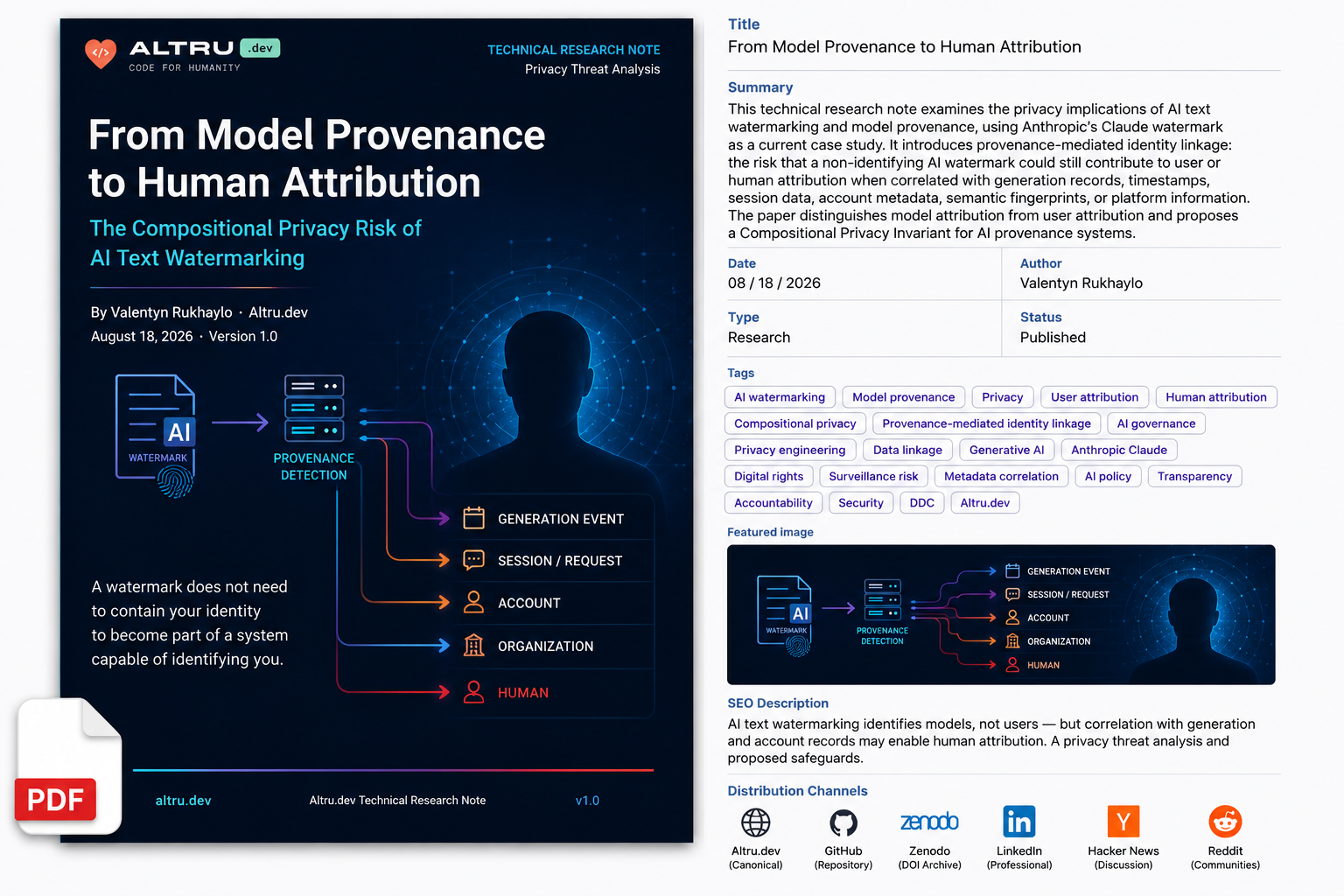
AI text watermarking is generally discussed as a mechanism for identifying whether a generative AI model participated in producing a piece of text. This technical research note examines a broader privacy question: whether model-level provenance can become human attribution through correlation with other records.
Using Anthropic's Claude text watermarking as a current case study, the paper introduces provenance-mediated identity linkage: the possibility that a watermark containing no user-identifying information could nevertheless contribute to identifying a generation event, session, account, organization, or person when combined with retained outputs, timestamps, request metadata, semantic fingerprints, account records, or external platform information.
The paper distinguishes Detection ≠ Provenance ≠ Linkability ≠ Attribution ≠ Identity ≠ Authority ≠ Ownership and proposes a Compositional Privacy Invariant for AI provenance systems.
The paper does not claim that Anthropic currently performs user attribution through Claude's watermark. It separates documented capabilities, derived architectural implications, hypotheses, and explicitly unclaimed behavior.
Repository and versioned public record:
https://github.com/altrudev/ai-watermarking-compositional-privacy
Author: Valentyn Rukhaylo, Altru.dev
Version: 1.0
First published: August 18, 2026